Showing posts with label novels. Show all posts

Thursday, 21 January 2021

Mrs Dalloway, a novel by Virginia Woolf


Mrs Dalloway, a short novel written in 1925 by Virginia Woolf (1882-1941) is an excellent treatment of the problem of loneliness and love, a theme which preoccupied the author.

The story opens as the heroine, society hostess Clarissa Dalloway, is making preparations for giving a party. Parties are designed to bring people together, but this novel raises the question of whether one can be even lonelier in a crowd.

As she moves about London doing her shopping, every encounter she has produces a response that is coloured by her earlier experiences, so that as we follow her stream of consciousness we learn everything that matters of her previous history. The events of her day are organised in a way that raises many questions about the possibilities of communication.

We also learn about the events in the day of Mr and Mrs Septimus Warren Smith, who never actually meet Mrs Dalloway, but there is a symbolic relationship between them, which is emphasised when one of the guests at her party, a specialist who has been treating Mr Smith, tells her about his suicide and produces in her a feeling of identification with the unfortunate man.

Septimus Warren Smith goes mad because, as a result of his experiences in World War I, he has lost all sense of contact with other people, is driven into the isolated emptiness of himself, and is dragged back by representatives of crude conventionality who imagine that by imposing their artificial social norms on him they can restore his sense of communication.

The pattern of the novel is woven with considerable delicacy, and the various elements from Mrs Dalloway’s past are brought into the present through a variety of persuasive devices. The prose is carefully cadenced and is, at times, almost poetic although never rhetorical. The individual sense of significance which provides the basis for the plot pattern is conveyed through style and imagery, through the suggestiveness and cunning of the language.

© John Welford

Wednesday, 21 March 2018

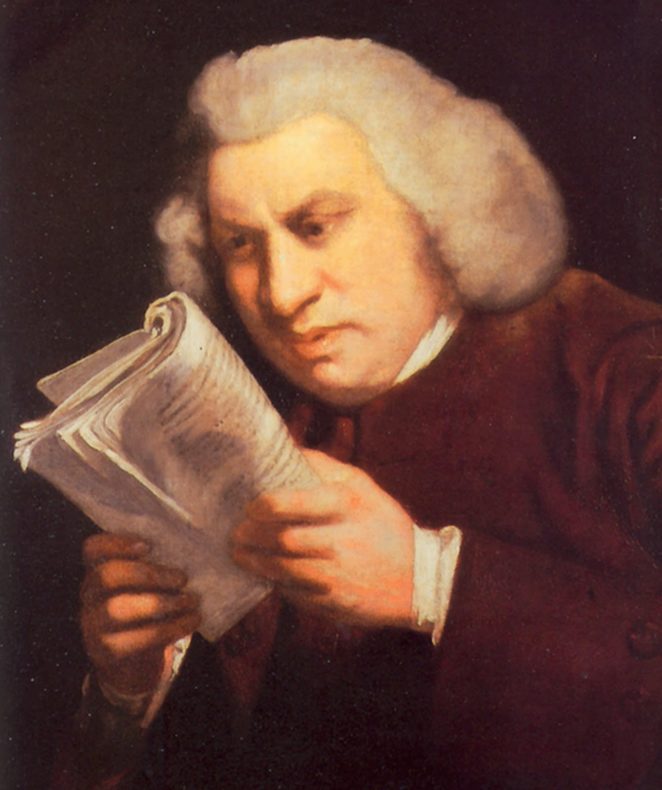
Rasselas, by Samuel Johnson


“The Full History of Rasselas, Prince of Abissinia”, which is usually abbreviated to “Rasselas”, was the only novel written by Dr Samuel Johnson (1709-84). He claimed that he wrote it in order to raise funds to meet the costs of his mother’s funeral in 1759.

Johnson had achieved fame by publishing his “Dictionary of the English Language” in 1755, but Rasselas is a very different kind of work.

It tells the story of a pampered prince who lives in the “happy valley” where all his physical needs are catered for but leaves him secluded from the outside world. However, he is dissatisfied with his lack of knowledge and escapes from the valley together with his sister, with a view to finding true happiness.

As a novel, Rasselas hardly counts as great literature, but Johnson was not a great storyteller, and the story is not the most important element of the book. It should instead be seen a parable – in the sense that John Bunyan’s “Pilgrim’s Progress” is a parable – and a peg on which Johnson could hang his thoughts and moral reflections about a wide range of topics.

Prince Rasselas engages in a number of lengthy conversations in which he discourses on matters including learning, reason, getting old, power, desire, madness and solitude. The views he expresses can be taken as those with which Samuel Johnson agrees or takes issue.

Apart from the famous dictionary, Dr Johnson is best known to us through the work of his friend and companion James Boswell, whom he first met in 1763. In his biography of Johnson (1791), and his well-known “Journal of a Tour to the Hebrides” (1785), Boswell recounted many conversations with Johnson in which the latter produced a large number of observations – including barbed and caustic remarks – that are often quoted even today. These have enabled us to form a view of this fascinating character.

However, the Johnson that emerged via the pen of Boswell had already been partly revealed many years earlier through Johnson’s own work, namely his “pot boiler” novel Rasselas.
© John Welford

Tuesday, 13 September 2016

Barnaby Rudge (by Charles Dickens) and autism


Barnaby Rudge was the fifth novel published by Charles Dickens (1812-70). It appeared in weekly parts in his short-lived journal Master Humphrey’s Clock, the final episode being printed in November 1841.

It cannot be denied that Barnaby Rudge is far from being one of Charles Dickens’s best known novels. It has never had the popular adulation of his other early novels, such as Oliver Twist or Nicholas Nickleby, and even Dickens would have admitted that it was not one of his better works. For one thing, a novel in which the title character is absent from the action for 19 consecutive chapters has surely got a serious flaw in terms of its structure.

Despite the book’s problems as a novel, the title character is a figure of considerable interest. Barnaby is put forward as a naïve character who is easily led astray, which is why he gets caught up in the anti-Catholic Gordon Riots of 1780 and is nearly hanged as a result. However, when one looks closely at the actions and demeanour of Barnaby, it soon becomes clear that Dickens is describing someone who is autistic, at a time when the condition was unknown and its sufferers were likely to be classed as “idiots” or mentally unsound, and therefore not worth taking seriously.


Autism

Autistic behaviour relates to an inability to abstract concepts from experiences and thus to link cause and effect or to plan for the future. The basic building blocks are present in the brain but they are not put together correctly. The comedian Eric Morecambe once famously remarked that he was “playing all the right notes but not necessarily in the right order”, and autism is something like that.

When one examines the typical characteristics of autism, and compares them with the text of Barnaby Rudge, one can see that Dickens must have known, at first hand, one or more people with the condition in order for him to be able to depict his character so convincingly.

It has to be remembered that there is a spectrum of autistic behaviour, such that individuals may be slightly or severely affected, or fall anywhere in between the extremes. This means that sufferers may exhibit some of the typical symptoms but not others, or they may display most of the recognised autistic behaviours but only to a mild degree. However, Barnaby Rudge does seem to tick most of the boxes when his behaviour is measured against the common definitions of autism.

It is clear that Dickens does not think that Barnaby is mentally defective. In chapter 25, for example, he mentions how Barnaby’s mother regards him, describing his actions when a child as deriving from something “not of dullness but of something infinitely worse, so ghastly and unchildlike in its cunning”.


Typical symptoms of autism as displayed by Barnaby Rudge

Autistic people often find it difficult to sustain personal relationships at an emotional level. Barnaby does not appear to be particularly close to his mother (who believes that she has long been widowed and therefore lives alone with Barnaby) and is perfectly happy to abandon her to join the rioters. He treats individual rioters alike as friends, whether he has known them for years or only five minutes. The one creature to whom he shows true affection is not human at all, namely his pet raven Grip whom Barnaby regards as his brother and from whom he is never parted (incidentally, it was this raven that inspired Edgar Allan Poe to write his famous poem “The Raven”).

A symptom of autism is sticking rigidly to a routine, even when circumstances change such that the action in question makes little sense. This tendency in Barnaby is noticed by the rioters, one of whom remarks that he “can be got to do anything, if you take him the right way”. Tasked with guarding a stable, and armed only with a flag, Barnaby continues to march up and down until overcome by a band of soldiers. The idea of running away from danger never crosses his mind.

Another indication is being unaware of the behaviour that is expected of one’s age and situation. This can be revealed as childish behaviour that continues into later life, such as a delight in toys and hobbies such as collecting car numbers, or, as in Barnaby’s case, an inability to make a distinction between humans and non-humans in terms of social status. His devotion to Grip the raven has been mentioned above, but this also takes the form of Grip being elevated above him in the pecking order: “He’s the master and I’m the man”.

Autistic people often show unusual degrees of sensitivity to sights and sounds. Barnaby is described at one point as “shutting out the light with his hands”, and at another as being able to recognise the sound of the footsteps of a dog as well of as its master.

Although being susceptible to panic attacks is not confined to those on the autistic spectrum, it is a regularly found symptom in such people. Barnaby’s mother recalls his “strange imaginings” and “terror of certain senseless things” in childhood. At one point he is anxious about the plotting and hatching that he imagines being done by clothes blowing about on a washing line, and at another he wonders about the motives of sparks from the fire as they ascend the chimney. This display of anxiety is therefore coupled with the typical autistic inability to distinguish between animate and inanimate objects and to anthropomorphise the latter.

Hyperactivity and abnormal movements are sometimes a symptom of autism. Barnaby’s mother remarks on his restlessness, and he thinks nothing of walking the twelve miles from Southwark to Chigwell, or of spending the whole day wandering through the countryside.

Speech abnormalities are common in autism. Barnaby sometimes loses the power of speech when excited, or he finds it difficult to express complex meanings. As with a number of the symptoms of autism, this is by no means unique to the condition and it is a common cause of confusion between autism and other forms of mental disability. Many autistic people have suffered discrimination because they have been labelled as “idiots” due to being unable to speak clearly, but it is noticeable that Barnaby’s friends know full well that this is not the case and that Barnaby understands situations as well as they do, if not better.

As should be clear from the above, autism is not synonymous with lack of intelligence, and many autistic people have been known to be extremely gifted in terms of abilities in limited areas. For example, the current writer has a relative who is severely autistic but has an encyclopaedic knowledge of the London Underground system. Barnaby’s special gifts include the ability to train his pet raven and to remember the faces and names of people whom he has not seen for many years.


Charles Dickens and autism


Charles Dickens conveys all of this knowledge of autism in his character of Barnaby Rudge, so the question remains of how he was able to do so when the condition was a hundred years or more from being recognised as such by the medical establishment. He may well have come across autistic people in his life and made careful mental notes of their behaviour. Some of his previously written characters might also be thought of as autistic to a greater of lesser degree. For example, Bill Sikes in Oliver Twist is never seen without his dog Bullseye, who appears to be the only creature to whom he shows any affection. A better case might be made for Smike in Nicholas Nickeby, who has suffered years of abuse from Wackford Squeers for being similar to Barnaby Rudge in a number of respects, but who is quite capable of being a close friend to Nicholas.

An even more fascinating thought is that Charles Dickens recognised many of these symptoms in himself, and that Barnaby is, to some extent, a self-portrait. It is known, for example, that Dickens would spend many hours wandering the streets of London at night, in a mirror image of Barnaby wandering the countryside during the day. Dickens did not find it easy to sustain personal relationships, with his marriage ending eventually in separation. Above all, perhaps, his single-minded pursuit of his craft, involving countless hours in the activity of writing to a punishing schedule as he completed each weekly or monthly part of his latest novel, might be construed as an autistic activity.

Indeed, it might be said that had Dickens not been so obsessively meticulous in observing his fellow human beings, he might not have been able to create characters such as Barnaby Rudge. Such accuracy and attention to detail perhaps require one to be somewhere on the autistic spectrum oneself.


© John Welford

Thursday, 21 July 2016

David Copperfield, by Charles Dickens: a summary of the plot


David Copperfield was the novel of which Charles Dickens was most fond among his works, and it is not difficult to see why. It was the first of his novels to be told in the first person, and there are many elements of it that have parallels with his own life. However, it would be a mistake to regard this novel as a hidden autobiography, because there is much in the book that is pure fiction, and it is as such that it should be judged.

The first chapter, dealing with David Copperfield’s own birth, is clearly told from hearsay, but in it we meet one of Dickens’s best female characters, the redoubtable but eccentric Aunt Betsey Trotwood, who comes to help David’s widowed mother at the time of his birth, but who leaves without a word when told that he is a boy and not the girl that she had always assumed he would be.

During his first few years David is blissfully happy with his mother, her maidservant Peggotty, and later with Peggotty’s family who are fishermen who live in a converted upturned boat on the beach at Great Yarmouth. Peggoty’s brother, Daniel Peggotty, looks after the children of his brothers, both lost at sea, and “Young Em’ly” becomes David’s childhood sweetheart.

However, things take a darker turn when David’s mother, who is easily manipulated, is persuaded to marry Mr Murdstone, who moves in together with his sister. The Murdstones are convinced that David has not been properly brought up by his free-spirited and kindly mother and do everything they can to reform his character. He is sent away to school, where his fellow pupils include Tommy Traddles and James Steerforth, for whom David acquires a devoted attachment.

When David’s mother dies in childbirth, he is taken from school and sent to work in the wine warehouse of Murdstone and Grinby. This is a remarkable episode in that the description of the location (by the River Thames) and work involved (pasting labels on bottles) directly parallels the work that the young Charles Dickens was forced to do at a similar age, an experience that scarred him mentally for life and which he told no-one about, not even his wife, except for the strong hints dropped here in “David Copperfield”. These hints were missed entirely by his contemporary readers.

At this juncture we meet another of Dickens’s best-drawn characters, the kind-hearted but always impecunious Mr Micawber, who provides lodgings for David during his time at Murdstone and Grinby. The portrait of Mr Micawber, who tries to support a growing family by borrowing money that he can never pay back, and is eternally optimistic that “something will turn up”, owes a huge amount to Dickens’s recollections of his own father, John Dickens. The two men, one real and the other fictional, both spent a period in a debtors’ prison through their inability to live within their means.

David runs away to Dover, where Betsey Trotwood, David’s only living relative, lives in a cliff-top cottage with Mr Dick, a slow-witted gentleman whom Betsey had rescued from mistreatment by his own family. Betsey reveals the softer side to her character as she takes David under her wing, making sure that he lacks for nothing, despite being a boy. However, she insists on calling him “Trotwood” rather than David.

When the Murdstones come looking for David, they are sent packing by Betsey, being given no more respect than the donkeys that trespass on her lawn.

David is sent to school in Canterbury, where he lodges with Mr Wickfield, who is Betsey’s legal and financial adviser. Mr Wickfield has a level-headed daughter, Agnes, and a clerk, Uriah Heep, who soon develops an abiding mistrust of David, partly because he regards David as his rival in love for Agnes, although Agnes never gives Uriah any encouragement, and David comes to regard her as a sister rather than a potential lover.

Uriah Heep is one of Dickens’s greatest villainous creations. He is secretive and scheming, hiding his true purposes under a cover of obsessive humility. As the story progresses it becomes clear that Uriah has a hold on Mr Wickfield, who turns to drink as Uriah becomes increasingly powerful.

The book contains a number of unlikely coincidences, one of which involves Mr Micawber turning up in Canterbury and happening to spot David at the home of Uriah and his mother, where David had gone in an attempt to try to bridge the gap between himself and Uriah. This brings Micawber into contact with Uriah, which is important for the final working out of the plot.

David visits Yarmouth again, this time accompanied by his old friend Steerforth, but things go disastrously wrong when Steerforth abducts Em’ly. This leads to Daniel Peggotty setting off on a long journey across Europe in search of his niece.

Betsey Trotwood pays a huge sum of money to enable David to train as an articled clerk under Mr Spenlow, whose daughter Dora takes David’s eye. When he announces that he wishes to marry Dora, her father takes great exception, and marriage is only possible after Mr Spenlow’s sudden death.

Betsey suddenly loses all her money under mysterious circumstances, so David has to abandon his aspirations for a legal career. He therefore seeks to better himself by learning shorthand so that he can work as a Parliamentary reporter, which is exactly what Dickens himself did. Like Dickens, David also starts writing stories which gradually attract public notice. While living in London he once again meets Mr Micawber, whose lodger is now Tommy Traddles, David’s old schoolfriend.

When David marries Dora, who proves to have no idea of how to run a household, he takes a small house in the suburbs and finds another close by for Betsey and Mr Dick.

Mr Micawber finds employment with Uriah Heep and slowly begins to unearth Heep’s business practices. Tommy Traddles, who is training to be a lawyer, is eventually able to recover Betsey Trotwood’s money, and Micawber denounces Heep as a villain who is consequently soon arrested for fraud.

David suffers a personal tragedy when Dora dies after a long illness, but he also helps to reunite Em’ly with Daniel Peggotty, who had discovered on his travels that Steerforth abandoned her in Italy and returned to England, as has Em’ly.

In the most dramatic scene of the book a yacht founders in a storm at Yarmouth. Ham Peggotty, Em’ly’s cousin and former fiancé, sets off to rescue the sailors, but is drowned in the attempt, along with the master of the boat who turns out to be Steerforth. The hero and the villain are washed ashore together.

The Micawber family and Em’ly emigrate to Australia. David becomes a successful writer and eventually marries Agnes.

There are many other notable characters in the book who play supporting roles. Among them may be mentioned Barkis, the carrier who uses the young David as his go-between to woo Peggotty, but who proves to be very tight with his money after they are married. There is Creakle, the schoolmaster in the “Wackford Squeers” mould who later retires from teaching and becomes an enlightened magistrate. Also worth a mention is Rosa Dartle, who has been cruelly treated by Steerforth but still loves him with a fierce passion from afar. 

The wealth of characters, plus a number of sub-plots that only touch on the main story in passing, mean that there are long intervals in the book when certain characters disappear from view only to turn up again many pages later. This may be considered a weakness of “David Copperfield” from a modern standpoint, but the characters in question are so well drawn that their re-appearance does not leave the reader trying to remember who they were. Many people, as well as the author, have come to regard “David Copperfield” as their favourite Dickens novel.


© John Welford

Sunday, 3 July 2016

Our Mutual Friend, by Charles Dickens: a summary of the plot


“Our Mutual Friend” was the last novel completed by Charles Dickens, being finished in September 1865. It has the most complex plot, with several strands being woven together. However, it also focuses on a number of typical Dickensian themes, such as class, education, and marrying for money.

Gaffer Hexam earns his living by pulling dead bodies from the River Thames and removing any valuables before passing them on to the authorities. One night he salvages a body that is believed to be that of John Harmon, who is the heir to a considerable fortune. This fortune consists of the ownership of several enormous mountains of rubbish (referred to as “dust heaps”) that were known in Victorian London to be sources of considerable wealth, as items of value were often found in such heaps.

If Harmon is dead, Noddy Boffin, who was the servant of John Harmon’s father, stands to inherit the fortune. Boffin takes on two employees, Silas Wegg and John Rokesmith. Wegg is a one-legged ballad seller, who is employed to read to the illiterate Boffin, and Rokesmith is to be his secretary. The Boffins also take Bella Wilfer, who had been engaged to John Harmon, into their home.

“Society” is represented by the aptly named Veneerings. They patronize the Lammles, who marry in the belief that each other has a fortune, only to discover their error too late. They then swear revenge on Society, which they do by befriending Georgiana Podsnap, daughter of pompous and opinionated John Podsnap, encouraging her to form a liaison with Fascination Fledgeby, who is a mean-minded hypocrite moneylender.

Gaffer Hexam has been falsely accused of the murder of John Harmon by Rogue Riderhood, who is another Thames-side scavenger. However, Gaffer is himself found drowned before Riderhood can claim the reward for solving the mystery. Gaffer’s devoted daughter Lizzie, who had helped her father in his work and is an accomplishment boat-person herself, takes lodgings with “Jenny Wren”, who makes dresses for dolls.

Lizzie becomes noticed by two potential suitors. One is Eugene Wrayburn, an indolent barrister who has become interested in the John Harmon case, and the other is Bradley Headstone, the schoolmaster of Lizzie’s young brother Charley. However, Lizzie has no interest in marrying either of them and runs away to a country cottage.

Noddy Boffin has become a miser, to the despair of Bella. He also becomes the target of Silas Wegg, who searches for a will that will disinherit Boffin.

Rokesmith, who is in fact the far-from-dead John Harmon in disguise, proposes to Bella, who rejects him in the belief that he has no money. However, Boffin then turns Rokesmith out of his house and Bella accepts Rokesmith’s second proposal.

Eugene Wrayburn has used underhand means to track Lizzie down and he goes to find her, followed by Bradley Headstone. Headstone assaults Wrayburn, leaving him for dead. However, he is rescued by Lizzie, thanks to her skill in handling a boat, and they are married while his life is still in danger.

Headstone had dressed himself to look like Rogue Riderhood, who is now a lock-keeper, with a view to placing on the latter the blame for the intended murder of Wrayburn. When Riderhood discovers this he tries to blackmail Headstone, but in the fight that ensues they both fall into the lock and are drowned.

Silas Wegg’s attempt to blackmail Noddy Boffin with a new-found will that left all the Harmon money to the Crown, backfires when Boffin produces a still later will that leaves the estate to himself. However, he also reveals that his miserliness had been a pretence to persuade Bella not to take a similar attitude towards money, and she and John Harmon are made Boffin’s heirs.

All the mysteries are resolved at the end, with the original confusion over John Harmon’s supposed death being explained by the fact that he had originally intended to observe Bella Wilfer, the bride intended for him by his father, in disguise, but the seaman with whom he changed identities ended up in the Thames. Being thought dead was therefore to his advantage, although that was not originally part of the plan.

The Lammles’s schemes come to nothing, and they are foiled at the end, as is Silas Wegg.

Justice is therefore served, and the couples who are united do so for love rather than financial motives. Some of the plot twists are somewhat contrived, such as the final will turning up at a convenient juncture, but that is not untypical of a Dickens novel. However, Dickens also gives us his usual panoply of strong character portraits and interesting psychologies, all serving the end of attacking class prejudice and mercenary attitudes.

One of the more revealing twists is the destruction of self-made Bradley Headstone and the rescue of idle Eugene Wrayburn, a moral judgment that the younger Dickens would not have made. The message of “Our Mutual Friend” is that it is a person’s motivation for their acts that matters; it is not what they are, but what they do and why they do it that determines their moral worth.

Another interesting sidelight worth mentioning is the minor character Mr Riah, an elderly Jew who helps Lizzie to escape from her rival lovers. For most of his career as a writer, Dickens had been troubled by reactions to his portrayal of Fagin in “Oliver Twist”, with many accusations of anti-Semitism being made. He always insisted that Fagin’s race and religion had nothing to do with the character that he gave him, although Fagin was probably based on a real Jewish villain named Ikey Solomon. In his last completed novel, Dickens was able to present his readers with a sympathetic portrayal of a Jew.

“Our Mutual Friend” is also notable for its strong female characters. Not only do we have Lizzie, who looks after her father and rescues Eugene, but Rogue Riderhood is also cared for by his daughter, despite his abuse of her, and Jenny Wren maintains her alcoholic and worthless father. These are all daughters whose “children” belong to the previous generation.


© John Welford

Wednesday, 1 June 2016

Emma, by Jane Austen: a summary of the plot


Emma, by Jane Austen (1775-1817), was published in December 1815 although the date on the original title page is 1816. It was therefore the last novel to be published in Austen’s lifetime, although Persuasion was written after she had completed the writing of Emma but was published after her death.

The story concerns Emma Woodhouse, who is introduced in the opening line as “handsome, clever and rich” and who “had lived nearly twenty-one years in the world with very little to distress or vex her”. The reader soon gathers that she believes herself to have a gift for understanding the needs and wishes of those around her, particularly in matters of the heart. As the novel proceeds she is brought to realise that she is deluded in this respect, and the shocks she suffers give her a greater degree of self-knowledge than she had previously possessed.

The events take place in and around the village of Highbury and concern the members of several families of varying fortunes. The Woodhouses are well-to-do, although Emma’s father is an elderly hypochondriac and she lost her mother when a child. Her elder sister is married to Mr John Knightley, whose brother George, owner of the local estate, takes a fatherly interest in Emma’s welfare, being 17 years older than her.

Emma believes that she has been responsible for engineering the marriage of her governess to a local widower, Mr Weston. She then takes it upon herself to do the same for her socially inferior friend Harriet Smith, believing that the perfect match will be the vicar, Mr Elton. She therefore persuades Harriet to break her attachment to the highly suitable Robert Martin, a farmer. Things go wrong when the vain and foolish Mr Elton thinks that Emma is matchmaking on her own behalf and proposes to her, to her disgust and annoyance.

Emma’s second attempt on Harriet’s behalf involves Frank Churchill, who is Mr Weston’s son but who was brought up by an aunt and uncle whose name he took. A comedy of errors ensues when Harriet misunderstands Emma’s hints and assumes that she is talking about Mr Knightley as the intended target. When Harriet duly falls for Mr Knightley, Emma begins to realise that she has feelings for him herself. At the same time, Mr Knightley begins to imagine that Emma is falling in love with Frank.

Emma’s next “victim” is Jane Fairfax, a young woman without a fortune who faces a future as a governess unless she can make a good marriage. Jane is staying with her aunt, Miss Bates, who is a gossipy middle-aged lady who rarely stops talking. Miss Bates is extremely proud of Jane, who is beautiful, intelligent, and a talented pianist and singer. Emma’s attitude towards Jane is tinged with more than a hint of jealousy.

Emma persuades herself that Jane is in love with a Mr Dixon, who is currently in Ireland. She has very little evidence for this fact, but that does not stop her from joking about it with Frank Churchill, and the two have a lot of knowing fun at Jane’s expense, although Emma clearly has no right to take such a line. Mr Knightley upbraids Emma for her attitude, and attempts to warn her that all may not be as it appears in terms of Jane’s private life, but Emma will have none of it.

Emma completely oversteps the mark at a picnic at which many of the villagers are present, when she insults Miss Bates in front of everyone. She is taken to task by Mr Knightley and suddenly realises that her behaviour has not been appropriate.

When news arrives that Frank Churchill’s aunt has died, Mr Knightley’s suspicions are confirmed, as Frank now announces that he is free to marry at last, and that his intended is Jane to whom he has been secretly engaged all along. Far from Emma and Frank being co-conspirators in the long-running joke against Jane, Emma has been Frank’s dupe. Her self-appointed status as the village’s matchmaker and fount of all knowledge regarding everyone’s romantic attachments is shown to be groundless.

The next shock to hit Emma is the realisation that Mr Knightley’s affections are not directed towards Harriet, as she had assumed, but herself. Now that Emma has been “dethroned” and come to her senses, Mr Knightley is able to declare his love for her, and she accepts his marriage proposal. Meanwhile Harriet’s former lover Robert Martin re-appears and proposes to Harriet. A double wedding concludes the story.

The novel illustrates very cleverly the importance of not seeking to control the lives of other people or to believe that one knows their innermost thoughts and desires better than they do themselves. “Emma” contrasts a variety of forms of selfishness and generosity against each other, portrayed most clearly through the characters of Emma and Mr Knightley respectively. Jane Austen makes the point in “Emma” that the most generous thing one can do when dealing with other people is to accept them for what they are, which is a lesson that Emma Woodhouse learns the hard way.


© John Welford

Friday, 18 March 2016

Little Dorrit, by Charles Dickens: a summary of the plot


Imprisonment is the central theme of “Little Dorrit”, whether the prison be one of iron bars, a closed heart or mind, or those of politics, administration and economics. The prison that looms largest is that of the Marshalsea, where people could be consigned for many years for being unable to pay their debts. Charles Dickens is here making use of his own childhood experience, when his father, John Dickens, became a “resident” for a few months in 1824, bringing humiliation on the whole family.

The book opens in a prison in Marseilles, where the chief villain of the story, Rigaud (who also uses the name Blandois) is introduced, along with several people who are detained in quarantine on their way to London. These include Arthur Clennam, who is returning home from China where his father has just died, to London, where he finds his mother living in a dismal first-floor room, confined to a wheelchair from which she conducts the family business.

At his mother’s house, Arthur meets Amy Dorrit (usually referred to as “Little Dorrit”), who is doing casual sewing jobs there. He follows her home and discovers that she lives with her father at the Marshalsea prison, where he has long been imprisoned as a debtor. Indeed, William Dorrit has become immensely proud of his status as “the father of the Marshalsea”. The Dorrit family also comprises William’s brother, plus another daughter and a son.

Arthur becomes curious as to why the Dorrits are in this situation, which is why he encounters the “Circumlocution Office”, a satirical invention on the part of Dickens that represents all the offices of government that exist solely to push pieces of paper from place to place without ever actually doing anything useful.

Arthur also meets the Meagles family (who had been fellow detainees at Marseilles) and the engineer Daniel Doyce. Having decided to have nothing to do with his mother’s business affairs, which he suspects are based on sharp practice, he goes into partnership with Doyce, who is a brilliant inventor but no good as a businessman. He also becomes reacquainted with Flora Finching, who had been the love of his life many years before but is now fat and silly. She is the daughter of Christopher Casby, the grasping landlord of a slum tenement, Bleeding Heart Yard, which is not far from the Marshalsea.

Clennam and Doyce visit the Meagles at Twickenham, where they meet Henry Gowan, who is courting Pet, the Meagles’ daughter. Also there is Pet’s maid Harriet, who is known as Tattycoram, having been “adopted” from Coram’s Foundling Hospital and who is mistreated by the Meagles family.

The sinister character Rigaud calls on Mrs Clennam. He is clearly in possession of a secret that greatly alarms the old lady, but she refuses to confide in her son, who is genuinely concerned for her welfare despite the rebuffs he suffers at her hands.

The major turning point in the novel is the revelation that William Dorrit is, after all, not a pauper at all but entitled to a large estate. This has come about through the efforts of Pancks, who is Casby’s rent collector but is shocked by the conditions in which the tenants of Bleeding Heart Yard are forced to live. On Arthur Clennam’s behalf, Pancks discovers the document that allows the Dorrit family to leave the Marshalsea.

However, William Dorrit is freed from one prison only to enter another, that of his own pretensions. He is convinced that he must now enter the society to which his wealth entitles him, and thus takes on all the trappings that that entails. He employs a governess, Mrs General, to educate his daughters in the ways of society, a move that horrifies Amy, who only wishes to be herself.

In undertaking a grand tour of Europe, the Dorrit family meet the now married Gowan and Pet (accompanied by Tattycoram), and Rigaud, at the convent at the head of the Great St Bernard Pass.

At Martigny, William Dorrit meets Mrs Merdle, who invites him to invest his money in her husband’s London bank. Many others have also done so, including Arthur Clennam. However, William Dorrit never returns to England, as he loses his mind at a dinner given in Rome by Mrs Merdle, addressing his fellow diners as though they were prisoners at the Marshalsea, and dies soon afterwards.

Tattycoram has been persuaded to run away by the mysterious Miss Wade, a strong-minded but self-tormenting young woman who is one of Dickens’s most interesting minor characters. She is traced by Arthur to Calais, where it is discovered that she possesses papers that have been stolen from Mrs Clennam by Rigaud. However, she refuses to surrender these. Arthur is convinced that these contain evidence that will be of benefit to Amy Dorrit.

Merdle’s bank collapses, and its owner commits suicide. The Dorrit fortune disappears as a result, as does the capital of Doyce and Clennam. Arthur now becomes a Marshalsea prisoner himself. However, truths begin to be revealed, based on the documents suppressed by Mrs Clennam and stolen by Rigaud. In particular, a codicil to her husband’s will had left money to Amy Dorrit, and Arthur turns out to have been only the stepson of Mrs Clennam.

In a dramatic scene, Mrs Clennam, who is being blackmailed by Rigaud, rises from her wheelchair and leaves the house, determined to find Amy and seek her forgiveness. The old house collapses, killing Rigaud in the process.

At the end, many prison doors are thrown open, with Arthur being released from the Marshalsea when the stolen papers are returned, and from his emotional prison in which he had refused to allow his growing love for Amy to show itself. Pancks also forces Casby to free his tenants from their servitude in Bleeding Heart Yard, with Pancks revealing Casby to be a hypocrite and oppressor. Arthur and Amy are married.


© John Welford

Monday, 7 March 2016

An interpretation of Alice in Wonderland


“Alice’s Adventures in Wonderland”, by Lewis Carroll, has attracted a great deal of critical attention since it was first published in 1865, much of it centred on the hidden meanings and allusions that it might contain. There are, for example, many references to people who were known to the author’s original audience of the three daughters of Henry Liddell, the Dean of Christ Church, Oxford.

Charles Lutwidge Dodgson, who used the pen name of Lewis Carroll, was a talented mathematician and logician who incorporated many verbal and logical tricks in his writing, and untangling these has given pleasure to a host of commentators ever since.

However, the thought that has occurred to me is that “Alice” can be read as a hidden attack on the Church of England, and possibly on Christianity as a whole. I do not know if this thought has been expressed elsewhere or if I am the first person to have spotted the signs – the latter seems unlikely somehow. I doubt very much if I have stumbled upon something that nobody has noticed or suggested before! A far more probable scenario is that this interpretation has been going the rounds for decades but I have simply not been well-read enough to have found it.

The key to this thought is Alice’s experience, early in the book, of eating and drinking things that change her size so that she can get through a door into a beautiful garden. She has already had the experience of falling down a rabbit hole into a strange new world. This struck me as being akin to the Christian idea of being “born again”, with the rabbit hole representing a birth canal, and the eating and drinking being symbolic of the bread and wine of holy communion. The beautiful garden is akin to the Garden of Eden.

Access to the garden is not easy, and indeed this is not achieved by Alice until after she has met many of the best known characters in the book, including the Cheshire Cat and the Mad Hatter. Likewise, the progress of the Christian convert is not supposed to be without its difficulties, and many experiences that both help and hinder can be expected before arrival in the “Promised Land”.

Other episodes in the book can also be regarded as Christian symbols, notably the trial in the final chapter that can be likened to the last judgment in the Book of Revelation.

Why do I say that “Alice in Wonderland” is an attack on the Church rather than an allegory in favour of it? This is because of the remark made quite early in the book by the Cheshire cat that this is a world in which everyone is mad. Even Alice is mad: “You must be”, said the Cat, “or you wouldn’t have come here.”

Once in the garden, Alice is in a nightmare world rather than a paradise. Despite the “bright flower-beds and cool fountains”, the roses are being repainted because they are the wrong colour and the world is governed by a queen who orders executions at the slightest excuse. A mad game of croquet is organised from which Alice is happy to escape to the relative serenity of the Mock Turtle’s world of verbal dexterity in which things almost make sense, but not quite.

In other words, if this world is symbolic of the Church of England after a convert has entered it, then it is a world of oppression alternating with nonsense in which language is twisted into shapes for which it was never designed.

Of course, “Alice” is a book designed for the amusement of children, which is why the underlying meaning that I have suggested is not made explicit. Nevertheless, I maintain that it is there all the same.

The question must then be asked as to why Dodgson might have wanted to express his doubts in this way, and that leads to the further question of why he might have had such doubts in the first place.

Dodgson was a lecturer in mathematics at Christ Church, Oxford. As the name might suggest, Christ Church was a religious foundation. Indeed, the college chapel doubles as the Anglican Cathedral of the Oxford Diocese and the head of the college is also the dean of the cathedral and must therefore be an ordained priest in the Church of England.

In Dodgson’s time, all resident staff members were expected to take holy orders. Dodgson took deacon’s orders in 1861 and should have proceeded to take priest’s orders a year later. However, he did not do so, and needed the express permission of Dean Liddell in order to keep his job. Various reasons have been suggested as to why Dodgson refused to become a priest, and one of those is that he was having serious doubts about the validity of Anglicanism.

It is known that Dodgson was interested in “alternative” forms of religious experience, such as Theosophy, and that he also underwent a personal crisis in the early 1860s in which he experienced a profound sense of guilt, the reasons for which are another source of debate. Whatever the cause, he would have had good reason to want to express his doubts about the Church of England in ways that were clear to him but not so to other people, particularly children.

Just at the time when he was having all these doubts, and appealing to Dean Liddell to be excused the next stage towards the Anglican priesthood, he was enjoying trips up the river with the Dean’s children and telling them stories about a strange world that one could only enter after “communion” with magic substances.

A coincidence? Maybe. Or maybe not! As I said above, it is quite possible that this account of the underlying meaning of “Alice” is common knowledge in some quarters. If not, I hereby claim to have made a fresh contribution to the understanding of “Alice in Wonderland”!


© John Welford

Tuesday, 1 March 2016

Mystery in A Passage to India, by E M Forster


The mystery around which much of the plot of Forster’s “A Passage to India” revolves is that of what actually happened in the Marabar Caves. Was Miss Quested molested by Dr Aziz? However, there are mysteries that go much deeper than that and it is these that give the novel its greatest strength.

A Passage to India was E M Forster’s fifth and final novel published in his lifetime, although he lived for another 46 years after its publication in 1924. It therefore represents his last exploration, in fiction, of the theme that pervades his work (the first four novels appeared between 1905 and 1910), namely that of the difficulty of human communication, summarised by the plea “Only Connect” that is the motto of “Howards End”.

Forster visited India twice, in 1912-13 and again in 1921-22 when he worked for several months as the secretary of the maharajah of a native (i.e. semi-independent) state. He was therefore able to get a close view of the situation of India under British rule, and to appreciate the problem of human connection from another perspective.

The very first line of the novel states: “Except for the Marabar Caves – and they are twenty miles off – the city of Chandrapore presents nothing extraordinary”. However, the caves do not enter the story until nearly halfway through the book, and the description given of them seems to belie that first line, as they would appear to be no more “extraordinary” than anywhere else in the area:

“… the visitor returns to Chandrapore uncertain whether he has had an interesting experience or a dull one or any experience at all. He finds it difficult to discuss the caves, or to keep them apart in his mind, for the pattern never varies, and no carving, not even a bees’ nest or a bat, distinguishes one from another”… It is as if the surrounding plain or the passing birds have taken upon themselves to exclaim ‘extraordinary’, and the word has taken root in the air, and been inhaled by mankind”.

In other words, the caves have no mystery other than what has been assigned to them by local people. They are therefore the place to which the obsequious Dr Aziz insists on taking a party of English visitors who wish to see “the real India”. He goes to enormous trouble to organise a rail expedition and picnic, his wish being to create the best possible impression.

The incident at the heart of the novel concerns Adela Quested, who has recently arrived in India to be married to an officer of the British Raj. At one point during his guided tour of the caves Dr Aziz becomes separated from Miss Quested, who is then reported as having run out of a cave in panic, stumbled down a rocky slope, and been taken back to Chandrapore by car.

The reader never knows exactly what happened to Miss Quested, although the best guess is that she had been affected by the heat and panicked in the darkness of a cave that she had entered alone. However, when she arrives back in Chandrapore in a distressed state the British officials are quick to point the finger of blame at Dr Aziz and make up a story that involves him making untoward advances to her. Aziz is arrested and put on trial.

There is now an almost universal wedge suddenly driven between the British and Indian communities. A form of hysteria seems to sweep through both the ruled and the rulers as all trust breaks down and the few characters who had previously tried to forge links of understanding between the races find their situations to be increasingly difficult.

As rumour and counter-rumour rush through the town it looks as though things could turn violent. The trial becomes very confused, with the British officials keen to convict Aziz but the key witnesses becoming increasingly uncertain about their evidence. Eventually, Miss Quested withdraws her charge and the trial collapses, which is interpreted by the local Indians as a major triumph.

The mystery of the Marabar Caves therefore remains unresolved, but so does that of how Briton and Indian can ever reach full understanding between themselves. Dr Aziz leaves town and becomes embittered as a result of his treatment by the British. At the end of the book he expresses his view that the British and the Indians will never be friends until the British have left India. Forster concludes by pointing to a deeper reason why this is so, namely that it is the land itself that makes friendship and understanding impossible:

“… the earth didn’t want it, … the temples, the tank, the jail, the palace, the birds, the carrion, the Guest House … They didn’t want it, they said in their hundred voices, ‘No, not yet’, and the sky said, ‘No, not there’”.

The mystery at the heart of A Passage to India is therefore whether there can ever be a true rapprochement between the races and religions that people Planet Earth. Forster leaves the question open, and therefore to continue as a mystery, because the situation of British India was clearly no solution and no alternative seemed likely to present itself.

In his earlier novels, Forster was inclined to offer an answer to the situation of “disconnection” that he presented. His solutions tended to oversimplify matters and therefore appear facile and unsatisfactory. In A Passage to India various unworkable solutions are presented, including that of walking away from the problem and leaving it for others to sort out. By ending the novel in the way he does, Forster recognises that this mystery of human connection is beyond the power of humans, or even gods, to solve. The mystery lies deep within the soul of India itself, and that is where its resolution must take place, if it ever does.


© John Welford