Monday, 7 May 2018

Rosencrantz and Guildenstern are Dead: a play by Tom Stoppard


Tom Stoppard took the title of his 1966 play from a line towards the end of Shakespeare’s “Hamlet”. All the main characters are dead, which leaves the concluding lines to be spoken by Hamlet’s friend Horatio and the Norwegian general Fortinbras. An ambassador from England announces that he has come too late to tell the Danish king that his orders have been obeyed and that “Rosencrantz and Guildenstern are dead”. 
These two minor characters appear much earlier in the play as spies sent by King Claudius to try to work out what is in Hamlet’s mind that could explain his bizarre behaviour. They are old friends of Hamlet and are greeted warmly at first but then less so as Hamlet is clever enough to work out their true purpose and taunts them about their duplicity. 
Later on, Claudius sends Hamlet on a ship to England, accompanied by Rosencrantz and Guildenstern. They are bearing a letter from Claudius that requests that Hamlet be killed on arrival, but Hamlet is able to switch the letter for one that condemns his two former friends to death. Hamlet is able to escape from the ship when it is attacked by pirates and return to Denmark, but Rosencrantz and Guildenstern are not so lucky.
Tom Stoppard was born in Czechoslovakia in 1937 but has lived in Britain since 1946. His widowed mother married a British army major, which therefore gave Tom and his brother Peter British citizenship. He began writing plays in the 1950s and in 1964 wrote a one act play entitled “Rosencrantz and Guildenstern Meet King Lear”, which evolved into the three act play in which King Lear plays no part.
Stoppard was interested in the many unanswered questions arising from “Hamlet”. Clearly, the characters were used by Shakespeare for a specific purpose, and they always appear as a pair with little to distinguish one from the other. They are also overshadowed by the much stronger character of Hamlet. However, what if they were put in the limelight and the other Shakespeare characters played bit parts? Also, what if their actions were seen in a comic light as opposed to being elements of a tragedy? These were the possibilities that inspired Tom Stoppard to write his play.
Stoppard turns everything on its head by concentrating on the times when Rosencrantz and Guildenstern are off-stage as far as Shakespeare’s play is concerned. One can imagine that the main action of Hamlet is happening on another stage in parallel to what one is seeing here. At times the two plays interact and a scene from “Hamlet” appears in Stoppard’s version.
One of the main themes of “Hamlet” is the main character’s musings on the nature of existence and the purpose of life, as exemplified by the famous “To be or not to be” soliloquy. For Stoppard, the same questions apply to his main characters, and much of the comedy of the play comes from their introspections and conclusions on these matters.
Act One
The play opens with the two courtiers flipping a coin and betting on heads or tails, which immediately poses questions about fate, chance, and the nature of reality. The coin always comes down heads, 92 times in a row, thus prompting the characters to reckon that they are subject to unnatural forces. The scene is therefore set for happenings that are beyond their control and which they will struggle to understand.
When the pair are summoned by Claudius and Gertrude to undertake their mission to spy on Hamlet, great play is made of Shakespeare’s apparent inability to tell them apart. This even extends to Rosencrantz and Guildenstern themselves. Hamlet’s central question of “Who am I?” is thus presented with a comic twist.
The travelling players from “Hamlet” also make an appearance in this act. Just like Rosencrantz and Guildenstern they spend a lot of time off-stage, so Tom Stoppard imagines that all these bit players might get together at such times. However, the play that they put on for the courtiers is a lot more bloodthirsty than the wordy and courtly performance they enact in “Hamlet”. During their “time off” they clearly have other preferences.
Act Two
In Act Two there are many interactions between Rosencrantz and Guildenstern, the chief player, the king and queen, and Hamlet. Questions of reality and unreality crop up with confusing frequency, aided by the contrast between what the players do on stage and off (they produce a dress rehearsal of “The Murder of Gonzago” which they perform in “Hamlet”), and always against the background of whether Hamlet’s madness is feigned or real.

Issues of life and death arise when the players foretell the fate of Rosencrantz and Guildenstern, and the couple are asked to find the corpse of Polonius after Hamlet has killed him in error, thinking that his victim was Claudius.
Act Three
Act Three takes place on the ship to England as Rosencrantz and Guildenstern escort Hamlet to England, sent there by Claudius in a bid to have Hamlet killed. Questions of existence arise at the outset because the pair have no idea how they got there and need proof that they are actually alive. They open Claudius’s letter and thus discover the king’s true purpose. However, Hamlet switches the letter while they are asleep.

Also on board are the players, who have decided to escape the expected wrath of Claudius. They have stowed away in barrels on deck, which also prove to be good hiding places for all the characters when the pirates attack. After the pirates have gone, Rosencrantz and Guildenstern discover that Hamlet has gone too.
When they look again at the letter they learn the truth about Hamlet’s treachery and have to face the fact that their fates are sealed. However, they cannot understand why they deserve to die. The chief player offers Guildenstern an intended consolation along the lines that everyone must die, but this enrages the courtier who takes the player’s dagger and stabs him with it. The player falls but then rises again, because his dagger is a theatrical one with a retractable blade. This provides another approach to the question of the reality of life and death.
In the final scene the two main characters muse on the existential issues that have pervaded the play but still fail to come to any satisfactory conclusions. Could things have been different? Could they have changed the course of events in either their own drama or the parallel one that keeps impinging on theirs? The lights go out on each of them in turn and the line “Rosencrantz and Guildenstern and dead” sounds as the final moment of the play.
Although this is a comedy, it has a number of messages and poses many questions. Just as there are no easy answers in “Hamlet”, so there are none here. An audience member will come away with the uneasy feeling that, as well as being the main character in his or her own life story, they are also a bit player in that of every other person they know, to a greater or lesser extent. 
Would a patron of this play who did not know “Hamlet” reasonably well get as much out of it as someone who did? The answer to that is probably No, because there are so many subtle references to Shakespeare’s play in “Rosencrantz and Guildenstern are Dead”. Also, it would be difficult for someone who was completely ignorant of “Hamlet” to be aware of the points of contact between the two plays, or even of the significance of the title. That said, the play is entertaining and enjoyable in its own right, and might be an interesting point of entry (if somewhat confusing!) to “Hamlet” for someone who had not seen it.
© John Welford

Tuesday, 3 April 2018

Winnie-the-Pooh was Canadian


Winnie-the-Pooh is one of the best loved characters in children’s literature of all time. The writer A A Milne (1882-1956) wrote a series of stories that were published as “Winnie-the-Pooh” in 1926 and “The House at Pooh Corner” in 1928, and Winnie also featured in a number of poems. The character of Winnie (also known as Pooh Bear) was based on the teddy bear belonging to Milne’s son, Christopher Robin Milne (1920-96).

However, the name “Winnie” was given to Christopher Robin’s bear after the black bear of that name that was kept in London’s Regent Park Zoo and which was a particular favourite of the young boy. And that is where the Canadian connection comes in.

Captain Harry Colebourn, the veterinary officer of the Second Canadian Brigade, bought a black bear cub for $20 after its mother had been killed by a hunter. He called the cub Winnie after his home city of Winnipeg. When the brigade moved to England as part of the preparations for World War I, Winnie (who was actually a female bear) came too, as the brigade’s mascot.

However, in 1914, when war broke out, the brigade moved to France and it would have been impractical for a black bear to travel to a war zone. Winnie was therefore left in the care of London Zoo, which is where she stayed until her death in 1934, having been permanently donated by Harry Colebourn after the war. She was therefore a fully-grown bear when Christopher Robin first saw her, some eight or nine years after her arrival. The boy would bring her gifts of condensed milk when he visited the Zoo. One can, one hope, forgive the sex change that Winnie underwent in becoming Pooh Bear.

There are two Winnie-the-Pooh statues in Regent’s Park Zoo. One is of a bear cub on its own, this being the work of Lorne McKean dating from 1981. The other was a gift from the City of Winnipeg and is a replica of the original in that city. This shows Winnie with Captain Colebourn, the former standing on her hind legs and being held by her front paws. The original statue, by Bill Epp, was made in 1992, with Harry Colebourn’s son Fred being the model for his father. The replica in Regent’s Park was unveiled in 1995 by Christopher Robin Milne.

© John Welford

Thursday, 22 March 2018

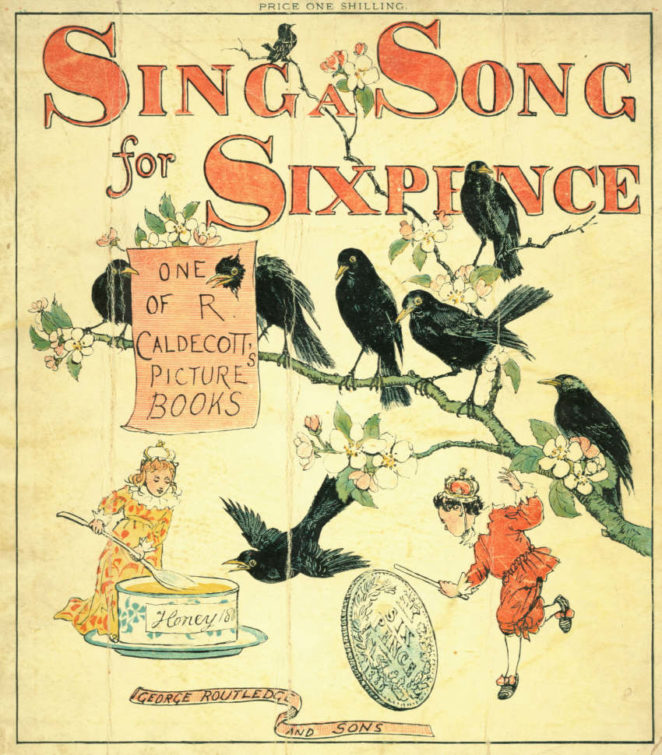
Sing a Song of Sixpence: a traditional nursery rhyme


Sing a song of sixpence, a pocketful of rye
Four and twenty blackbirds baked in a pie
When the pie was opened the birds began to sing
Wasn’t that a dainty dish to set before the king?
The king was in his counting house counting out his money
The queen was in the parlour eating bread and honey
The maid was in the garden, hanging out the clothes
When down came a blackbird and pecked off her nose

This familiar nursery rhyme has been going the rounds for hundreds of years and its popularity owes much to the dramatic images it presents of birds flying out of pies and noses being pecked off unsuspecting maids. But does it perhaps have a more sinister meaning than the nonsense that it would appear to present?

Nobody is completely sure about the origin of this rhyme, but it may have a similar root to that of “Little Jack Horner” in that both refer to items being hidden in pies. The latter rhyme is almost certainly a reference to an incident during the 16th century Dissolution of the Monasteries carried out on the orders of King Henry VIII, so it is entirely possible that “Sing a song of sixpence” has a similar theme.

King Henry ordered the break-up of England’s religious houses after he had declared himself to be the head of the English Church in opposition to the Pope. This came about after he had divorced his first wife, Catherine of Aragon, and married his second, Anne Boleyn, who was fated to fall from grace even more spectacularly. Neither queen had been able to provide Henry with what he most desired, namely a male heir.

So that accounts for the king, the queen (Catherine) and the maid (Anne). In “Little Jack Horner” the pie contained the deeds of monastic houses that were being conveyed to the king, so the blackbirds could easily be the same, or black-clad protestant clergymen who were only too happy to seize the deeds and present them to the king, in the expectation of rewards and preferments coming their way. On arrival, much “singing” would take place and the king would have plenty of “sixpences” to count in his counting house.

However, one particular blackbird, namely Thomas Cromwell who was King Henry’s Machiavellian chief minister, would later play a decisive role in the fall of Ann Boleyn who would lose considerably more than just her nose.

That is just one possible explanation, and others have been suggested. At any event, one can be assured that this simple little ditty has a much deeper meaning than might be apparent at first sight, whatever that meaning might be.


© John Welford

Wednesday, 21 March 2018

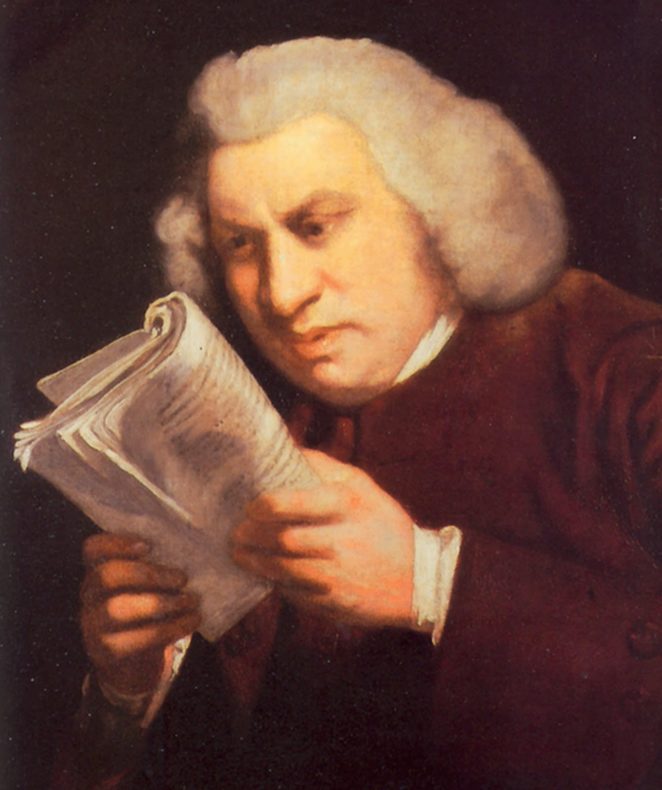
Rasselas, by Samuel Johnson


“The Full History of Rasselas, Prince of Abissinia”, which is usually abbreviated to “Rasselas”, was the only novel written by Dr Samuel Johnson (1709-84). He claimed that he wrote it in order to raise funds to meet the costs of his mother’s funeral in 1759.

Johnson had achieved fame by publishing his “Dictionary of the English Language” in 1755, but Rasselas is a very different kind of work.

It tells the story of a pampered prince who lives in the “happy valley” where all his physical needs are catered for but leaves him secluded from the outside world. However, he is dissatisfied with his lack of knowledge and escapes from the valley together with his sister, with a view to finding true happiness.

As a novel, Rasselas hardly counts as great literature, but Johnson was not a great storyteller, and the story is not the most important element of the book. It should instead be seen a parable – in the sense that John Bunyan’s “Pilgrim’s Progress” is a parable – and a peg on which Johnson could hang his thoughts and moral reflections about a wide range of topics.

Prince Rasselas engages in a number of lengthy conversations in which he discourses on matters including learning, reason, getting old, power, desire, madness and solitude. The views he expresses can be taken as those with which Samuel Johnson agrees or takes issue.

Apart from the famous dictionary, Dr Johnson is best known to us through the work of his friend and companion James Boswell, whom he first met in 1763. In his biography of Johnson (1791), and his well-known “Journal of a Tour to the Hebrides” (1785), Boswell recounted many conversations with Johnson in which the latter produced a large number of observations – including barbed and caustic remarks – that are often quoted even today. These have enabled us to form a view of this fascinating character.

However, the Johnson that emerged via the pen of Boswell had already been partly revealed many years earlier through Johnson’s own work, namely his “pot boiler” novel Rasselas.
© John Welford

Pussy Cat, Pussy Cat, Where Have You Been? A traditional nursery rhyme


Pussy cat, pussy cat, where have you been?
I’ve been to London to look at the Queen.
Pussy cat, pussy cat, what did you there?
I frightened a little mouse under her chair.

This little rhyme may have its origins in an actual incident in which a cat played a small part in the life of a monarch and got the best of the deal.

Cats are renowned for doing exactly what they want to do and being no respecter of persons. The old saying “A cat may look at a king” bears out this truth, and may indeed originate with the incident that gave rise to the rhyme.

The monarch in question was Queen Elizabeth I, but the cat remains nameless. It seems to have been an elderly tomcat that wandered round Windsor Castle and went wherever he felt like going. One day he decided to settle down for a snooze underneath a large chair that was actually the throne used by the Queen when dealing with official business and holding royal audiences.

As the cat slept on, the Queen arrived, as did her courtiers and the dignitaries, possibly foreign ambassadors, who had been granted an audience.

All the scraping of feet on the tiled floor, and maybe the occasional barked order, caused the cat to wake up in a state of panic. He did what all cats do under such circumstances and ran for safety – right underneath the Queen’s robes and between her feet, much to the alarm of everyone assembled and especially the most powerful person in Europe, namely Queen Elizabeth I.

The Queen screamed and flunkies ran after the cat as it tried to flee from the room. They caught it and – after the audience was over – brought it to the Queen so that due sentence could be passed.

However, Her Majesty, now fully recovered from her fright, was able to see the funny side of the affair and was prepared to be lenient. She gave a royal command that the cat was to be allowed to continue to wander round the castle as he wished, as long as he did a good job by helping to kill rats and mice.

Cats have always been useful in vermin control, and the tradition has continued down to the present day of giving due respect to cats in high places. For example, two regularly seen residents of London’s Downing Street are government employees named Larry and Palmerston. Larry is the latest holder of the office of Chief Mouser, which is a huge step up from his previous life as a stray tabby rescued by the Battersea Dogs and Cats Home.

Larry, the Number 10 cat, has eventually learned to tolerate the presence of Palmerston, who belongs to the Foreign Office, although there have been disagreements between them in the past. The verbal squabbles in the Cabinet Room have been as nothing to the real catfights that have taken place in the street outside!

© John Welford

Monday, 19 March 2018

Jack Sprat: a traditional nursery rhyme


Jack Sprat could eat no fat
His wife could eat no lean
And so between them both
They licked the platter clean

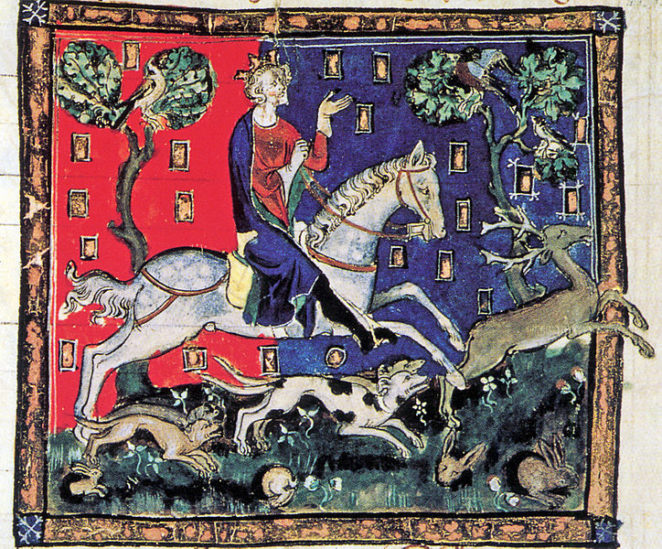
This familiar nursery rhyme may have its origin back in the 12th century when King Richard I set off on a crusade and left the realm of England in the care of his younger brother Prince John. John was the youngest of four sons, and thus the runt of the litter – or “Jack Sprat”.

John’s wife, Isabella of Gloucester, was renowned for her personal greed. She had, after all, gained all the property belonging to the earldom of Gloucester after her two sisters were disinherited in her favour by her marriage agreement to John.

However, the action mentioned in the rhyme probably had a more laudable motive than might appear at first sight. When Richard was on his way home from the crusade he was captured by Duke Leopold of Austria, who handed him over to the Holy Roman Emperor who in turn demanded a massive ransom for his release.

John and Isabella then set about gathering the money by all means available. They exhausted their own funds and then set about getting as much as they could from the rest of England, including raising taxes on clergy and laymen to the value of a quarter of their property.

They thus “licked the platter clean” in their efforts to bring Richard home, which were eventually successful. John’s subsequent unpopularity stemmed in part from this attempt to support his more popular brother, despite the fact that Richard only spent a few months of his ten year reign in England.


© John Welford

I Had a Little Nut Tree: the meaning behind a traditional nursery rhyme


Many traditional English nursery rhymes have their origin in actual historical events. “I had a little nut tree” is one such.

The rhyme
I had a little nut tree
Nothing would it bear
But a silver nutmeg
And a golden pear.
The King of Spain’s daughter
Came to visit me,
And all for sake
Of my little nut tree.
Her dress was made of crimson
Jet black was her hair,
She asked me for my nut tree
And my golden pear.
I said “So fair a princess
Never did I see;
I will give you all the fruit
From my little nut tree.”

The meaning
This simple nursery rhyme refers to the dynastic marriage between Catherine of Aragon (daughter of King Ferdinand and Queen Isabella of Spain) and Prince Arthur, the son and heir of King Henry VII of England. 
The speaker of the rhyme can therefore be taken as Prince Arthur, or his father, or the whole of England. 
The marriage plans went awry when Prince Arthur died within a year of the 1501 marriage. King Henry, who was always careful where money was concerned, did not want to return Catherine’s dowry so he quickly proposed Plan B, which was that she should marry King Henry’s younger son, also named Henry, when the latter was old enough (he was not yet 11 years old when Arthur died). 
The nut tree is therefore the source of the wealth of England that King Henry was willing to trade with Spain. Nutmeg refers to the spices that English trade with the Far East was bringing in, and pears are shorthand for England’s agricultural produce. 
These commodities are England’s silver and gold, in that Henry was hoping to acquire some of the wealth that Spain was accumulating as a result of its explorations in the Americas. Henry may have regretted that he had turned down the chance to finance Christopher Columbus’s voyage in 1492, and been mindful that it was Ferdinand and Isabella who had done so and that they were now reaping the benefits. He now had an opportunity to repair some of the damage.
As far as England was concerned, “all the fruit from my little nut tree” was a price well worth paying for a share in the wealth of the Americas.

© John Welford